Memory
The following is a transcript of the narration I wrote and recorded for my debut solo performance at Cluster Museum in Ann Arbor, MI on January 17, 2026. The piece I performed that evening is called “Memory” and combines modular synthesis and live-audio processing. The narration enters in the final fifteen minutes of this forty-five-minute-long work, and the audio is heavily distorted thanks to the noisy unpredictability of my Landscape Stereofield. At Cluster Museum, I provided printed copies of the text copied below for audience members to read after the performance. Also, as you will read, I drew heavily on the work of Ypsilanti writer Linette Lao in the creation of this work.
This piece is about memory. When Chien, Kim, and Thea invited me to perform here at Cluster Museum tonight, I immediately began exploring ideas I’ve never approached before in my creative career. In fact, this is my first ever public performance on these instruments. Ideas clearly play a significant role in the creative process, but I don’t think they are the most important component. Ideas are silent unless they are voiced by people and materials that give them a presence in the physical world. They cannot exist if they don’t have a place to be. They will not be heard, observed, nor felt if there is no audience to experience them. Something that excites me so much about Cluster Museum is that it is a new place that fosters new ideas, adventurous and embryonic works across artistic disciplines that may struggle to flourish elsewhere in our local arts community. I’m grateful to have the chance to make a contribution along these lines. And, I think it is very important that Cluster Museum exists now and is able to persist as long as it can.This piece, specifically this part of this piece, ended up differently from what I planned even as recently as Monday morning. The idea to add recorded narration to everything else you’ve heard was one of the first I had. It came from my memory of a talk by the composer Roger Reynolds that I attended in 2010, when I was in the first semester of my graduate studies at the University of Michigan. Reynolds was in Ann Arbor as a guest of the university to mark the fiftieth anniversary of ONCE, an experimental music festival he helped organize from 1960 to 1966 when he was a student here. I saw him as part of a panel discussion, and his prepared remarks included pre-recorded narration that accompanied the prepared remarks he shared live in the room. I don’t remember much of what Reynolds said [1], but, clearly, the style of his presentation made an impression on me. Creating this piece has served as a strong reminder to me that any creative work is steeped in the memories and lived experience of the person or people who make it. These sources are not always apparent on the surface [2]. In addition to my memory of an event I attended over fifteen years ago, many more recent experiences and interactions with people and places have shaped my performance tonight. Even my memories of this room [3], as limited as they are, helped form this piece. I was drawn to Linette’s zine by the striking print on the cover and because it is about the place where I live. After I read it, the work resonated with me because it uses personal memories as a vector to explore a broad history that both includes and stretches beyond Linette’s own experience. This perspective connects many of the creative works and people who have inspired me the most in recent years. It yields a recognition of and resistance to oppression that I admire. 1893 Ypsilanti Cyclone Damage at the Chinese Laundry does so beautifully with its multimedia materials, as the following passage demonstrates:
At first, Chinese men could start laundries because it was filthy, hard work. Because it was, “women’s work.” When washing machines were invented, white men wanted in on the business and resented the Chinese laundries. Hand laundries, run mainly by Chinese men, were in competition with steam laundries, run by mostly white folks. Laws were weaponized against the hand laundries — set up to punish or destroy them. Fees, licenses or ordinances made things harder.
In earlier versions of this text, this is where I would get stuck. I became overwhelmed with questions about the two central references I’ve made and whether it even makes sense to put them together. To resolve this, I’ve had to investigate the way my creative mind works. The memory of Roger Reynolds’ 2010 presentation at the University of Michigan is the first idea I had when I started working on this piece about a month ago. Honestly, it is not an experience I think about very often, but I couldn’t push it away. At that point, I hadn’t even encountered Linette’s zine, and it took me until Tuesday to figure out why they fit together. The political perspective of 1893 Ypsilanti Cyclone Damage at the Chinese Laundry is something I aspire to artistically. There are many other things I have read, seen, and heard over the last decade that primed me to feel this way, and Linette’s zine is only the most recent example of a kind of thinking and artistic being that feels best to me at this point. Until now, I’ve never made a creative work that deals with this desire, this goal, and its urgency as explicitly as this performance does. I’ve found it easier to take such a position as a writer, scholar, and educator, but my training as a composer did not prepare me to put my social values into my work. Overwhelmingly, the normative modes of white and male identity I was shown in music school and have experienced professionally ever since only uphold the social and political status quo. And, I have struggled to find ways to both be creative as a composer and not participate in that activity, because it does not align with how I feel about the world. Paradoxically, Roger Reynolds’ 2010 visit to the University of Michigan and the zine 1893 Ypsilanti Cyclone Damage at the Chinese Laundry connect because they represent different things to me. These sources mark two points on either end of the line of my artistic experience, one indicating a future I strive towards and the other a past [4] I need to unlearn and move beyond in order to achieve my goals. This piece is about memory. It is true memory can take us back in time and help us relive past experiences. But, I think I remembered Roger Reynolds’ talk in the Rackham Building over fifteen years ago so I could feel how far I’ve come since then. The world certainly has changed a great deal since 2010, and it seems inarguably imperative that we must make sure we go far enough in every way we resist the current oppression that impacts us directly, our neighbors, strangers, anyone — especially if they are trans, an immigrant, unhoused, or starving in Gaza — so that it can’t happen again. I think there is art that can help us do this. I wonder what all of you will remember about this performance because it will never happen again. To be clear, I will perform again, but, even if I set out to recreate everything I’ve done tonight, it would not be the same. Your memories represent this music’s longevity. I wonder what it will feel like for any of you if, in fifteen or sixteen years, you unexpectedly revisit tonight’s performance. I hope you feel like you’ve come so far from now.
[1] I do remember one of the stories he told with the accompanying recordings, which shared Reyonds’ memory of meeting the composer Michael Daugherty for the first time. Michael remains a Professor of Music at the University of Michigan and, in 2010, played a key role in organizing the ONCE Festival celebration. Through his pre-recorded voice, Reynolds described Michael playing piano for him, improvising something impressive. I also think he shared an anecdote about spending time with Michael at IRCAM, the French research center focused on electronic music, computing, and other kinds of music technology. [2] Iwas a Boy Scout when I was in middle school, and, during campouts, I would sometimes drift off to one of our troop’s large tents and stand right next to one of the long, taught lead lines connecting the top of the tent to a stake in the ground. I would press my ear to the rope and pluck it, I would pinch the line at different points to change the pitch, and move my fingers up and down wildly to make the sound more noisy and extreme. Only I could hear this. I haven’t been able to music like that again, in a manner so tactile and visceral with such an unmediated connection between me and what feels like pure sound, until I started working with the instruments and devices I am performing with right now. [3] The last time I visited Cluster Museum I grabbed a copy of Linette Lao’s zine, which is entitled 1893 Ypsilanti Cyclone Damage at the Chinese Laundry. It is a wonderful work of research, storytelling, and autoethnography that focuses on the experience of Hing Lee, a Chinese immigrant who operated hand laundry businesses in Ypsilanti and Ann Arbor at the turn of the twentieth century. [4] One reason I became stuck writing this text is that it was taking too much time for me to fully analyze the politics of Reynolds’ visit, mostly because they are implicit and complex. As an esteemed guest of the university whose only public talk invoked Michael Daughtery, a senior faculty member here, Reynolds clearly aligned himself with an empowered status quo on campus. Also, as I have recollected my experience in 2010 in the creation of tonight’s performance, I have spent time thinking about one of Reynolds’ own pieces that I heard performed: Portrait of Vanzetti, a 1962 work for narrator, electronics, and chamber ensemble. That work’s subject is inherently political as the text comes from the writings of Bartolomeo Vanzetti, the Italian immigrant and anarchist who, along with his comrade Nicola Sacco, was unjustly convicted of murder in 1921 in a trial that is widely considered the product of anti-Italian racism, xenophobia, and capitalist politics. Sacco and Vanzetti were executed in 1927. In 2010, I felt Portrait of Vanzetti was deeply radical, but now I understand that Reynolds only deals with his intimate emotional relationship to his subject’s tragic circumstances. He does not confront the materiality of Vanzetti’s victimization by the same legal system whose abuses Linette both includes and details in 1893 Ypsilanti Cyclone Damage at the Chinese Laundry. As a result, Portrait of Vanzetti feels empty to me now, and represents a kind of neutral creativity I am no longer interested in.
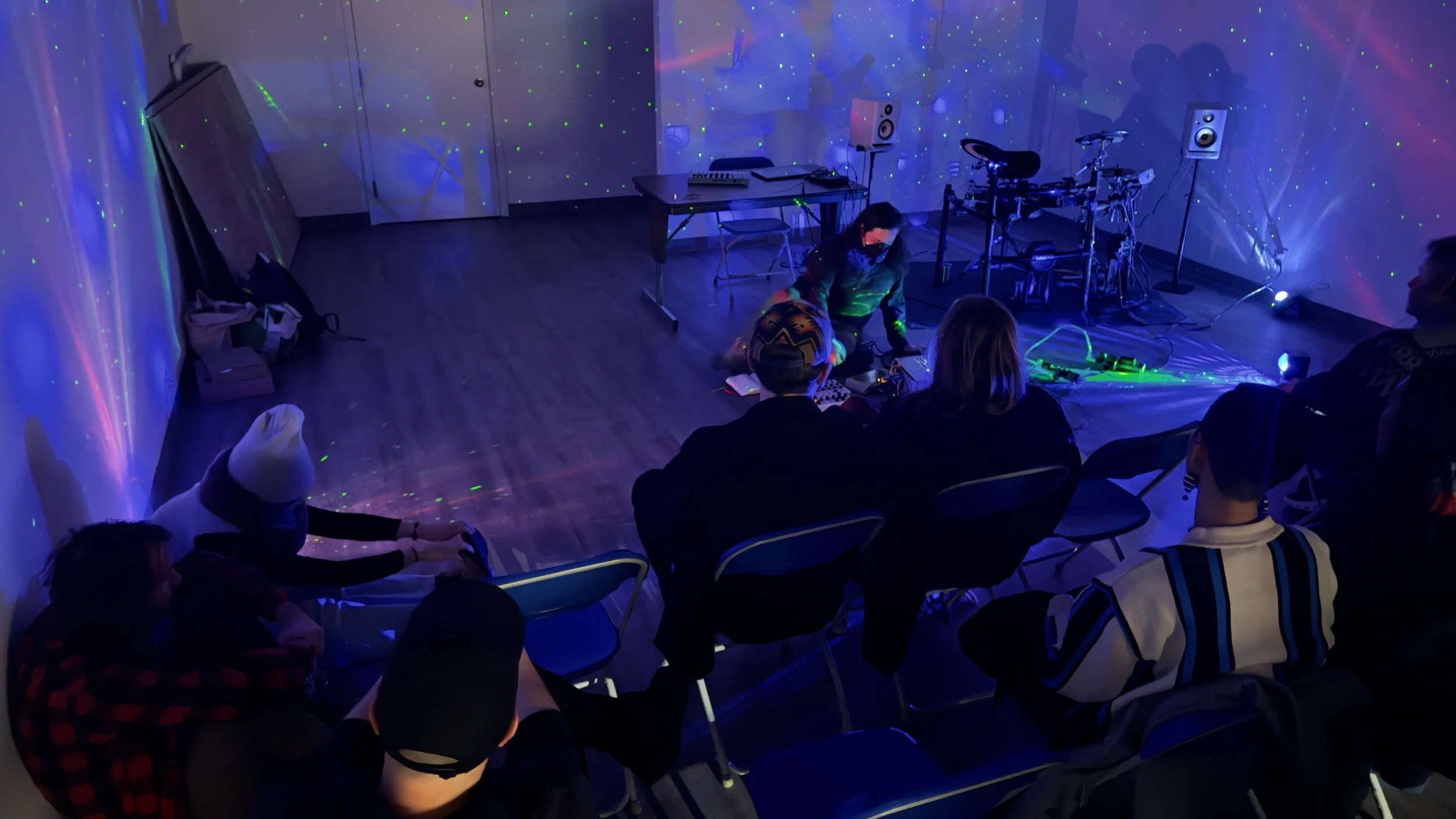
Photo of me performing “Memory” at Cluster Museum in Ann Arbor, MI on January 27, 2026 (credit: Chien-An Yuan)